
Corporate mergers and divestitures have become a critical part of today’s business. In this article, we will discuss about what a divestiture program looks like and a typical work stream that should be created for a successful divestiture.
Divestiture of a company will require multiple business teams to work together both from seller side as well as buyer side. While, this article focuses on seller side, we will also touch base on various points related to buyer side.
A typical divestiture program is governed by Transition Service Agreement (TSA) that defines the services included as part of the divestiture. Usually the buyer and seller would engage with a consulting firm and/or use a legal team (internal or external) to define the TSA.
Generally, TSA services are categorized in various areas such as HR, Finance, IT, Compliance, Real Estate, procurement etc. and this leads to forming various work streams. Once a program is kicked off a PMO office should set up a work stream level kick -off meetings that provides overarching governance, program management expertise and ensures that TSA terms/ clause / extension and work stream specific details are understood, planned, executed, and monitored in a timely manner. PMO team should closely work with all work streams, capture status update, and provide guidance on program status & direction.
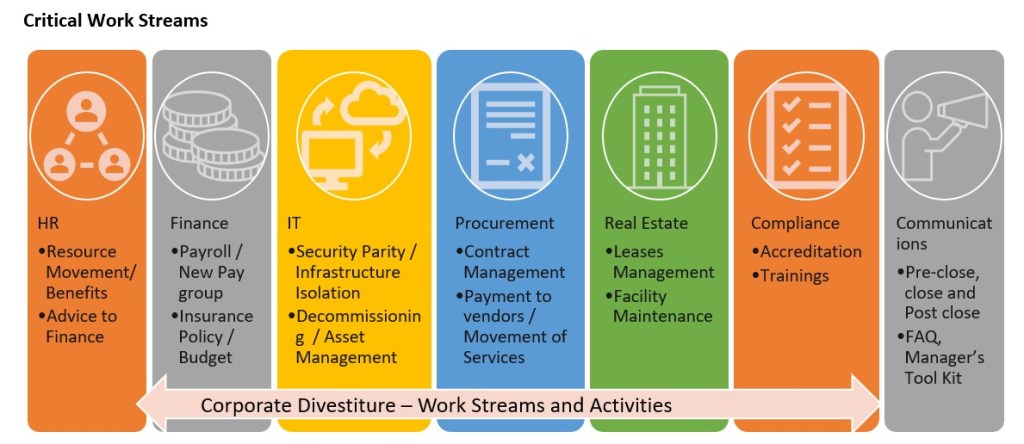
Let’s discuss on what should be the focus area of various work streams in a divestiture.
Transition Service Agreement (TSA)
- Transition Service Agreement must have a detailed information on various requirements and terms so teams don’t run into issues about the Licenses and responsibilities. Due various reasons the TSA terms may end up being vague or at very high level. While it may be beneficial to keep some of the TSA terms vague so, teams can work around or adjust the scope of work with mutual consent however, it may create legal challenges or may become expensive to either buyer or seller or both.
- Considering buyer and seller both may put different work stream on their side, buyer and seller must be on same page by sharing their overall project plan, schedule etc. at work stream level and program level.
Human Resource Work Stream

- In most divestiture companies may make decision on transferring resources from one organization to other. Such agreements are made ahead of time while the TSA is defined. HR team tracks such resource transfer as well as transfer of resources depending on the level of integration with the divested company.
- TSA may outline 30-60-90 day plan.HR typically looks at what resource is moving where and inform Finance team
- HR can provide a payroll / template to Finance. HR systems such as Workday can be used to pull such templates and reports
- HR would need to identify the list of resources that would need the “continued system access” so, they can re-hire them later if needed
- Buyer should inform seller about the new payroll vendor
- Payroll- may require a new GROUP. Hence, Finance team must be informed for the same.
- Buyer must be planning to set their own “Pay roll “Software e.g. ADP. Usually the buyer may ask for “Payroll template”.Such transfer of payroll may require a regulatory /IRS approval related to Federal Employee identification Number (FEIN) set up.
- HR teams should have clarity on various benefits e.g. “Short Term disability” /”Long term disability” etc. that the transitioned team members are entitled to. Consideration should be given for the team members who may be on long leave while the divestiture could be in progress.
Depending on when the divested company gets their payroll ready, the first pay date of the divested company should be determined. Similarly, the benefits need to be tracked.
Finance Work Stream

- Payroll: Key focus for the finance team should be to identify employees to move to new pay group, think about how it will work with HR and benefit, how would the contingent workers be taken care of etc. Payroll and account payable (AP) are the critical areas for finance team
- Each divestiture has different entanglement. FSA benefit transfer can be a big item to take care. In addition, teams should understand the insurance policies specially during the “transit period” and define a strategy to either own or cancel the existing policies when the divestiture is underway.
IT Work Stream

- Need to identify the level of integration and define a divestiture strategy. If the divested company is highly integrated then, it may involve separating out Infrastructure, Network, Firewall, Data center, Security tools, File Sharing arrangements (SFTPs), Application & Data transfer etc., whereas if the divested company was not highly integrated then, companies may just be able to remove any relevant integration points and security tools etc.
- IT work stream should define various phases and begin discussions to isolate the infrastructure, remove security tools, begin to define responsibilities for the divested companies new data center creation or migration to cloud and finally plan to decommission the assets in current data centers
- Buyer must pay attention to ensure that after the divestiture the companies are secure from the cyber threats and look for the equivalent security tools that the parent company may have deployed.
- Buyer should be looking at the IT contracts and licenses that the parent company has established and attempt to advantage of the existing relationship to save cost
- As defined in TSA, the seller should facilitate and supporting the divested company to untangle security tools, resolve any IT contract/ license issues, and ensure that, parent company is not losing the security parity during the divestiture
- Teams must be fully aware of the risk of removing the security tools and impact to the parent organization’s ability to monitor the end point, track vulnerability and apply patches etc.
Security Tools Transition from parent company to the divested company

- Security as well as Non-Security Software tools needs to be taken care. Divested company can get started with identifying all the software that parent company’s IT department typically installs on the end user machines. Typically, the SCCM (Software Configuration & Change Management) team can provide an initial list of the software. Divested company and parent company may have to resolve the license issues.
- Divested company may try to get best discounts possible that parent company gets but depending on the software vendor and depending on the vendor contracts, such discounted license fee may or may not be given the divested company. In some situation, the transfer of licenses e.g., DUO may work from the parent company to divested company but in some situation, these may not work. So, it’s critical to identify all the security tools.
- While the security tools (e.g. ZScaler, Proof Point, Forcepoint, CrowdStrike, Anti Malware software etc.) may need to be there until the divestiture is completed, the non-security tools (e.g. Adobe, Zoom etc.) can be taken off earlier.
Procurement Work Stream

- Procurement team should work with all other teams specially the Finance/ Billing team
- Should focus on Contracts and it’s portability. There may be many vendors who may be working with the company being divested and procurement team typically works with those vendors and port the contracts.
- Procurement team notifies them how the vendors can continue to send their invoices & payments…
- One of the biggest thing for Procurement is to make sure that, “relationship manager” for example “HR” or others must notify Procurement team otherwise, procurement team may make the payment where as the contract may have already been ended.
- Risk for procurement team is that, they may be paying to vendors / contractors that they should not be paying.
- Procurement team should have a list of assets/ procurement contracts etc. They should work with parent company’s procurement and vendor management software team and want to make sure clean accounting by the end of the month w.r.t invoices etc..
- Buyer may be moving their services and hence, these needs to be discussed ahead. Divesting company should identify vendors early
- Establish a process of what will be reimbursed and what not!
- Seller may pay the bills ..and adjust it later on..after the TSA period is over.
- TSA should have line items for all the “services” that is covered under TSA.
Asset Management Work Stream

- IT Asset Management team should be focused to ensure that all the assets of the divested company is being tracked and reported to finance team
- Asset Management team should verify all the physical assets by visiting various data centers and sites to ensure the records are up to date
- To ensure data security, and data drives must be decommissioned (destroyed or migrated) accordingly to the parent organizations data destruction policies. Companies can agree to engage the external White glove services to ensure data security
- All IT physical assets transfer must be documented. Legal teams should be engaged to document the transfer of ownership of the assets. Such transfer of ownership will ensure that, parent company do not get sued for any incorrectly disposed data drives and expose any confidential data
Real Estate Work Stream

- Real estate team should be identifying current real estate leases and reassign the lease to buyer
- Seller should provide the “Lease schedule” to the Buyer and buyer should set up leases/ payment and ensure that, rent payments are transferred to the buyer as per the defined timeline.
- After closing of the deal, real estate team may have to update their “Lease Management system / IT application e.g. CO_STAR. To remove payments.
Compliance Work Stream

- Compliance team generally work with multiple other teams and take care of any accreditation at the buyer and seller side
- Team should facilitate / track compliance trainings for the divested company / employees especially if they deal with HIPAA or other such compliance…and future trainings needs to be suppressed
- Seller should provide a deadline to complete the trainings and after that point, the buyer should be on their own to ensure accreditation trainings are taken care.
Communications Work Stream
- Communications team should plan for various communications such as Pre-close, Close and Post-close communications
- Communications teamwork with TSA legal and other teams to communicate the TSA dates etc. and ensure that any major issues etc. are taken care/ communicated
- Communications team’s focus should be Day 1 as well as ongoing “Communications”, “Prepare FAQs”, “Customer talking points”, “Manager’s tool kit”
- Program manager should also, be working with Buyer’s leadership on “communication coordination”

Conclusion

In conclusion, a successful corporate divestiture hinges on meticulous planning and seamless collaboration across various work streams. From HR to Finance, IT, Compliance, and beyond, each area plays a crucial role in ensuring a smooth transition.
The establishment of a robust PMO office and the adherence to the Transition Service Agreement (TSA) are foundational elements that guide the divestiture process, providing structure and clarity to both the seller and buyer. By engaging with consulting and legal experts, organizations can navigate the complexities of the divestiture, ensuring that all terms and conditions are meticulously planned, executed, and monitored. Ultimately, the success of a divestiture lies in the ability of all involved teams to work in unison, maintaining open communication and a clear focus on the strategic objectives, thereby paving the way for future growth and stability for both entities.

